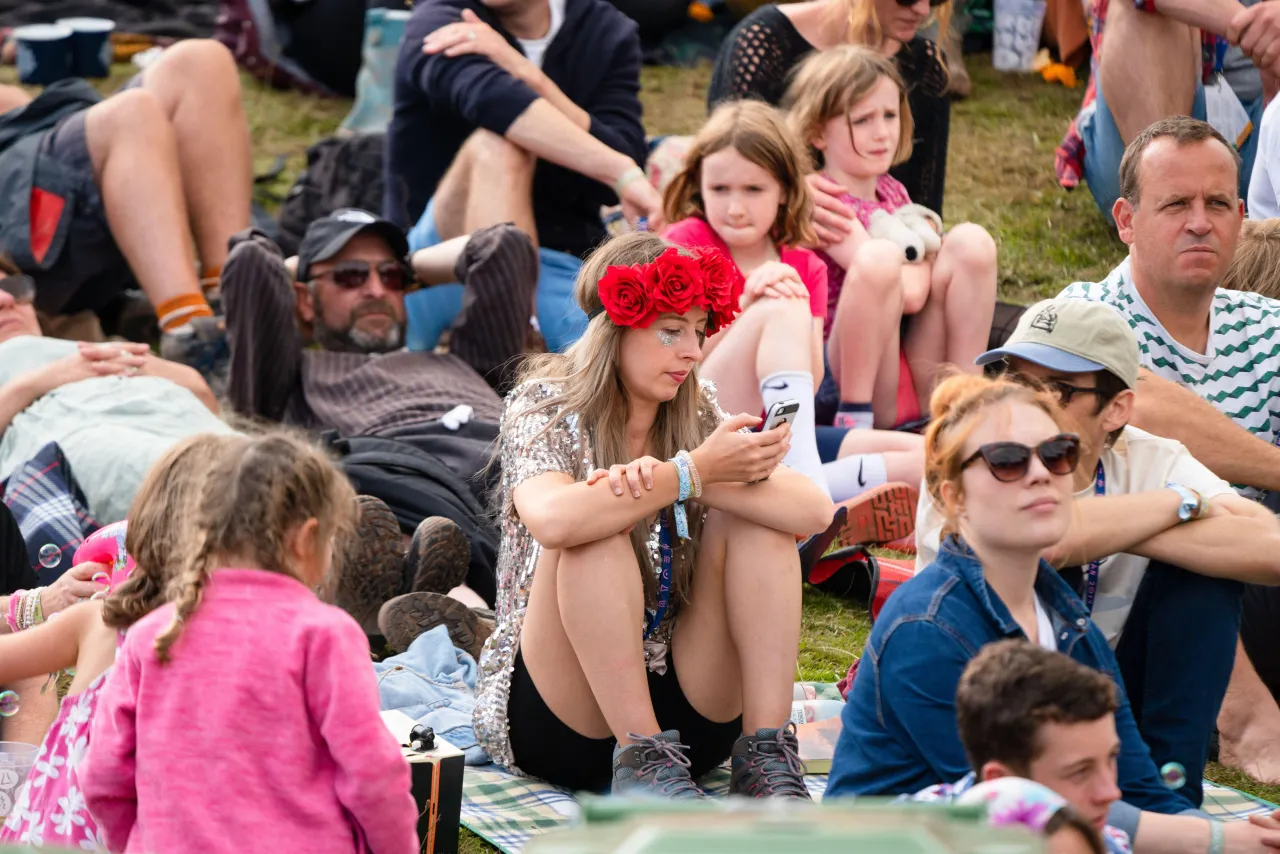
Image licensed via Alamy
Welcome to another instalment of Dear Boom, our advice series where the creative community helps solve the industry's trickiest problems. This week's question cuts close to the bone for anyone who's ever answered an email on Christmas Day or felt a creep of dread the moment they try to relax for an evening.
"I'm a freelancer, and I haven't properly switched off in years," writes our reader. "Even on weekends or holidays, I'm checking emails, thinking about deadlines, worrying about where the next job is. I know I need a break. I'm exhausted. But every time I stop, I feel guilty. Like I'm risking everything I've built."
If that resonates, you're not alone. The responses on Instagram and LinkedIn—from illustrators, creative directors, brand designers and studio founders—were among the most candid we've received.
In short, the freelance community doesn't just recognise this problem. Most of us are still living it.
The anatomy of freelance guilt
First, let's make one thing clear. The guilt you feel when you're not working isn't random or irrational. Think about it: when you were employed, the structure of work was imposed from outside. You had official office hours, annual leave, and someone who told you to log off and go home. But when you work for yourself, none of that scaffolding exists… leaving your brain free to spiral and panic.
There's also something specific to creative work that makes it worse. Most of us aren't doing a job we merely tolerate. We're doing something we chose, something that bleeds into our identity. And that can make switching off feel doubly wrong.
Then, of course, there's the practical issue of finances. Freelance income is rarely steady, you need money to live, and so your brain starts to see "rest" as "threat". As designer Ryan Stephenson puts it: "The pressure of knowing 'it stops when you stop' is real. We can't pretend that anxiety isn't there."
Yet the risk of not earning has to be balanced with the risks of working too hard. If you spend too much time running on empty, it will quietly degrade your thinking, creativity and judgment: the actual product you're selling. And ultimately, burnout will take you out of the game for much longer than a proper holiday ever would have.
In this light, failing to rest isn't really the "safe" option. It's actually more risky than taking time off.
Build the structure that makes rest possible
Understanding the problem is one thing. Solving it requires practical architecture. As Mark Richardson, founder of Superfried, puts it: "The solution is to address the source of your anxiety: your lead pipeline. If you have a regular stream of projects and retainers, you won't worry about downtime because you'll be reassured by the secured work."
Even then, though, the habit of never resting can be a difficult one to quit. In which case, freelance advocate Matthew Knight suggests creating a simple holiday policy. "Set yourself a target of time you must take off over a year, and a maximum number of days you can work without a break," he recommends. "Even if you can't take off full days, reduce your hours, nail your to-do list, and take the rest of the day to rest."
Part of this is about reframing how you think of rest in general: not as "unproductive" time, but a different type of productivity.
As Ben Mottershead, founder of Never Dull Studio, puts it: "Time off is essentially a self-initiated project, with the goal being to refill your battery. When you start to treat switching off and downtime as actually no different to client projects, marketing costs, R&D, etc., you'll take it more seriously and feel a lot less guilty. "
Illustrator Shruti Singh takes a similar line. "Rest isn't a risk, it's part of the process," she stresses. "I come back twice as aligned and stronger every time I take some intentional time off."
Vicky Tomlinson, co-founder of Kind & Wild Branding Studio, sums up the central contradiction here. "When you're completely frazzled, you don't do your best work," she points out. "Clients and agencies aren't getting the best of you when you're running on empty. Rest is part of the job. A break is actually the faster route."
What commissioners actually think
It's not just fellow freelancers who'll tell you this, by the way. Those on the other side of the brief are also singing from the same hymn sheet.
Take Tom Munckton, executive creative director at Fold7 Design. "Right now, I'm looking for a freelancer to jump in on a project," he explains. "Whenever I'm in this situation, I start by going through those I've worked with over many years. Sometimes they're busy, sometimes they're free. Sometimes they're taking much-needed time off. But the point is, it doesn't stop me from trying them every time.
"If you're good, you're easy to work with, and you've put energy into building a stable pool of clients, you should never fear losing everything if you take a break. Commissioners will always be looking for the next opportunity to bring you in."
It's natural to think that if you're not online the moment that email comes in, you'll lose out. But Tom argues differently. "Clients come to you for you," he points out. "They're buying into a person. Go quiet for a couple of weeks, and they won't walk: they'll ask where you've been. We produce our best work when we're at our best. Rest is part of the process, not a break from it."
In truth, the guilt, fear or paranoia of not working 24/7 never fully disappears. But the good news is, it can become quieter. Especially once you've built the pipeline, the relationships and the structures, that mean time away doesn't feel like falling off a cliff.
At the end of the day, it's pretty simple, really. The freelancers most at risk of burnout are often the most conscientious. But rest isn't a betrayal of that. It's what makes it possible.
Editor's Picks




Trending



Latest Jobs
Growth Marketing Lead at Anthropic
Full-time·San Francisco·$320,000 – $400,000
Digital Content Designer at British Heart Foundation
Full-time·London·£37,000 – £40,500
Marketing Manager at Penguin Random House UK
Full-time·London·£40,000 – £44,000
Copywriter at David&Goliath
Full-time·Los Angeles·$75,000 – $95,000
Staff Producer, Studio Central at DoorDash
Full-time·San Francisco·$176,800 – $260,000
Director, Creative Technology at Code and Theory
Full-time·New York·$160,000 – $225,000