Is there a productivity crisis in agencies we're not talking about?
Why does it take more people to complete a project than it used to?

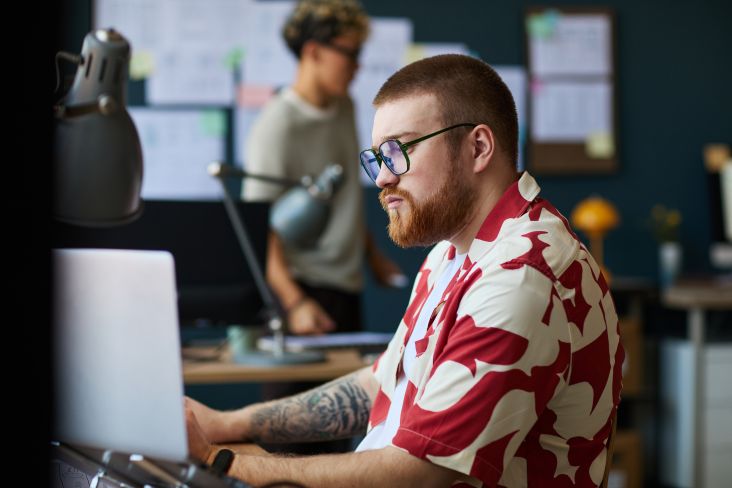
Are we less productive in the creative industries? Image licensed via Adobe Stock
When Joy Nazzari, founder of DNCO, sat down for the Creative Boom podcast recently, she raised something that stopped me in my tracks. It wasn't about burnout, mental health or the usual suspects of creative industry discourse. It was about something more fundamental, more uncomfortable. The basic economics of running an agency since 2020.
"We had the same turnover throughout the pandemic," Joy explains in the podcast. "But we had no profit. And the reason is, we needed more people to be able to deliver the same amount of work... because we were working from home and productivity just tanked."
She's quick to stress that DNCO is now back in a healthy place, with solid profits again. But the experience left a lasting impression. As Joy recognises, this is "a conversation that people hate having". And while she's careful to acknowledge the nuance, the grey areas, and the fact that no single factor was to blame, it's clear that for some agencies this wasn't a blip.
"People want bigger salaries, but productivity is lower, so you have to hire more people," she says. "Somehow the maths aren't mathing."
Joy is equally clear that this isn't simply about where people were working from. Macro-economic pressure, rising client expectations, and a generation of juniors who'd never experienced studio life all play a role. But she does think the industry needs to be more honest about trade-offs. Of course there are benefits to working from home. But, as she puts it, "We can't be surprised that there are consequences too."
She isn't suggesting, of course, that people working remotely are lazy. But she is pointing to the way distributed working can slow things down at an organisational level. She recalls situations where meetings were booked eight weeks in advance because in-office days didn't align. In a fast-moving industry, that kind of friction quickly adds up.
Frankie Guzi, director of Studio DRAMA, which develops custom typefaces for global brands at speed, echoes this concern. "Speed doesn't come from adding more people or pushing longer hours," he argues. "It comes from proximity, time spent together, solving problems as a unit." That's why Studio DRAMA works together in the office four days a week, remote for just one. "We make decisions in the room, rather than distributing them across email inboxes, calendars and Slack channels," he explains.
Dirk van Ginkel, co-founder at Moah, notes that on the whole, "while remote and distributed teams offer benefits, they have increased handoffs, documentation, and decision latency, often requiring staff dedicated solely to coordination." Sunnie Mae Schwartz, a publicist, adds that whilst individual productivity can be higher working from home, "something meaningful was left behind when we went remote at scale"; specifically, the casual, in-between conversations that lead to immediate problem-solving. "Small friction, repeated daily, adds up."
One might add that it's one thing for veteran designers to work remotely, but how are juniors expected to absorb the myriad complexities and subtleties of agency life—learn by doing, watching and being challenged in real time—unless they're in the studio, surrounded by mentors, on a daily basis?
Complexity inflation
At the same time, everyone quoted here agrees that hybrid working is by no means the only challenge to productivity. As Max Ottignon, co-founder of Ragged Edge, puts it: "I do think the standards and expectations of what goes into a rebrand have rocketed up.
"Look back at some of the case studies—even for huge brands—from 10 years ago, and they almost seem quaint in their simplicity. Now every project requires a full design system, motion behaviours, scalable illustration systems, and usually some sort of customised type, testing against a much broader range of stuff. The digital product requirements are on a different level."
This observation is echoed by Emily Shaw, CEO and founder of Tribe: "I've noticed that expectations and complexity are higher for the same budgets," she says. Tanvi Jadhav, co-founder of Black*C, puts it more bluntly: "Clients want 2026 complexity on 2019 fees."
Inevitably, the technological revolution we're in the midst of factors into this too. "I think AI has skewed expectations pretty heavily," says creative director Robin Wicker. "Not because it's necessarily 'there' yet, in terms of production, but because marketing teams and creative services just assume it 'is'. A lot of our challenge currently is perception management."
The over-delivery trap
Niall McRiner, design partner at Studio Every, raises a further point. "In such a competitive and squeezed market," he asks rhetorically, "is the definition of 'getting it over the line' actually over-delivering by 20% to leave a lasting impression?"
"Over-delivery is another contributory factor that is rife in the industry, where agencies feel they are forced to do anything they can to secure ongoing work and nurture relationships," agrees Owen Williams, co-founder of sixredsquares. "All of which is being fuelled by the economic and technological doom and gloom that often gets peddled on platforms such as LinkedIn."
Alex Dixon, founder of DACRE, summarises the vicious cycle many agencies find themselves in. "Brands have had their budgets squeezed, got more channels to manage and fewer resources to do so, which then gets knocked onto agencies and studios. Negotiations are driven harder by the rise of procurement, which results in inflated scopes at undercut rates and over-delivery."
Mixed picture
It's worth noting that not all agencies believe there's a productivity crisis right now. For instance, Richard Longmuir, creative director at Launch, says: "I've actually seen the opposite in my agency. We've been more productive as a team working remotely, still meeting up regularly though, and have seen growth each year."
Ryan Antooa, founder and chief creative officer of STUDIOFORM, is feeling similarly positive, saying: "We've actually been putting less people on same-size projects because we've nailed down scope, timelines, deliverables and team member responsibilities way before the project even begins."
"I see this less as a productivity issue and more as a structural one," says Stephen Painter, a strategic partner to design-led businesses. "Many studios are still priced, staffed and measured on pre-2020 assumptions, while the work itself has become more ambiguous, iterative and emotionally demanding. The headcount creep feels like a symptom of that mismatch rather than the root cause."
Honest conversation
So perhaps the real question isn't whether there's a productivity crisis, but whether the industry is willing to openly acknowledge the divergence between how agencies operated before 2020 and the realities of how creative work happens now. The economics, expectations, and working patterns have all shifted. But have the business models kept pace?
"The industry needs to have an honest conversation and run some experiments in the way it funds itself," believes James Duru, global creative director at Inito. "Moving from a full-service-based model to one which blends service and product to build reliable recurring revenue. If, as we often posit, our work creates such immense lasting value, why is it paid for in such a short transactional manner?
"I feel if we don't have these conversations, more-for-less will be the consistent complaint of agency owners, leaders and founders," he adds. "And financial success will be for the few who can position themselves as a luxury service or experience."
Perhaps Danni Mohammed, founder and CEO of Gentle Forces, puts it best. "I do wonder if some of what we're calling productivity loss," she says, "is really a mismatch between how creative work actually moves and the systems we've inherited to manage it; many of which were built for a very different way of working."
Editor's Picks


Trending


Podcasts

Editor's Picks
Further Reading