Christmas ads of 2025: Comfort characters, practical cheer and a generational shift
From familiar faces to value-first storytelling, this year’s festive ads mix nostalgia with real-world warmth.
Every December, Britain gathers around its screens for a new kind of festive tradition: the release of the year’s Christmas ads. What started as simple, heart-tugging tales of love and togetherness has grown into a full-blown season of cinematic spectacle, complete with mascots, sequels, and orchestral soundtracks.
Over the past five years, these ads have traced our collective journey: the quiet reflection of 2020’s lockdown Christmas; the cautious optimism of 2021; the purposeful reassurance of 2022; the joyful escapism of 2023; and the glossy, character-driven fantasy of 2024. Each year, they’ve mirrored the national mood, shifting from empathy to excess as the country tried to shake off crisis fatigue.
The real questions this year is: with the cost of living still biting and a brutal Autumn Budget on the horizon, will brands keep turning up the sparkle or take things back to something simpler? Will we see another year of lavish magic and familiar mascots, or a return to the intimacy and humanity that the pandemic brought about? Either way, the Christmas ad season has become so much more than a marketing moment. It’s a mirror to who we are, and how we’re feeling, as the year draws to a close.
First we'll review 2025's festive ads as they're released. And then we'll get the verdict from the creative industry on who did it brilliantly, which ads were hit and miss, and what they felt the overall theme was from this year's creative offerings.
Coca-Cola: Refresh Your Holidays
Coca-Cola leans on both nostalgia and innovation this year, evolving its legendary festive platform with Refresh Your Holidays. Developed by WPP Open X (led by VML), the campaign reframes the brand’s trademark cheer for a modern audience, inviting people to slow down, reconnect, and savour a moment of joy “with every sip.”
The hero film, A Holiday Memory, follows a mother overwhelmed by festive prep who rediscovers what matters most after a single, icy gulp of Coke and a glowing ornament that sparks child-like wonder. Alongside the TVC, Coca-Cola debuts an AI-powered re-imagining of its classic Holidays Are Coming trucks in a bis to show that heritage and tech can coexist when handled with restraint. The iconic caravans will again roll into towns worldwide, bringing light displays, music and the unmistakable red trucks that have defined Christmas advertising for generations.
Global VP of creative strategy & content Islam ElDessouky describes this year’s work as a tribute “to all those who craft the magic of the season.” It definitely feels like a refresh, rather than a reinvention. In true Coca-Cola fashion, its still sparkling, still sentimental, and still the world’s unofficial start to Christmas.
Marks & Spencer: Driving Home
M&S casts Dawn French as a weary commuter inching through gridlock to Chris Rea, then flips the jam into a rolling party when her fairy alter-ego conjures an M&S food truck. Inside is the spread people actually buy the brand for, threaded with a Tom Kerridge cameo that nods to chef-led range development.
The spot is simple and legible, with one set-piece, one song, and strong table appeal. On top of that, it sells abundance without sliding into excess, which feels right for the year. Perhaps most importantly, it gives you a good festive chuckle about the very real struggles of Christmas commuting.
ASDA: A Very Merry Grinchmas
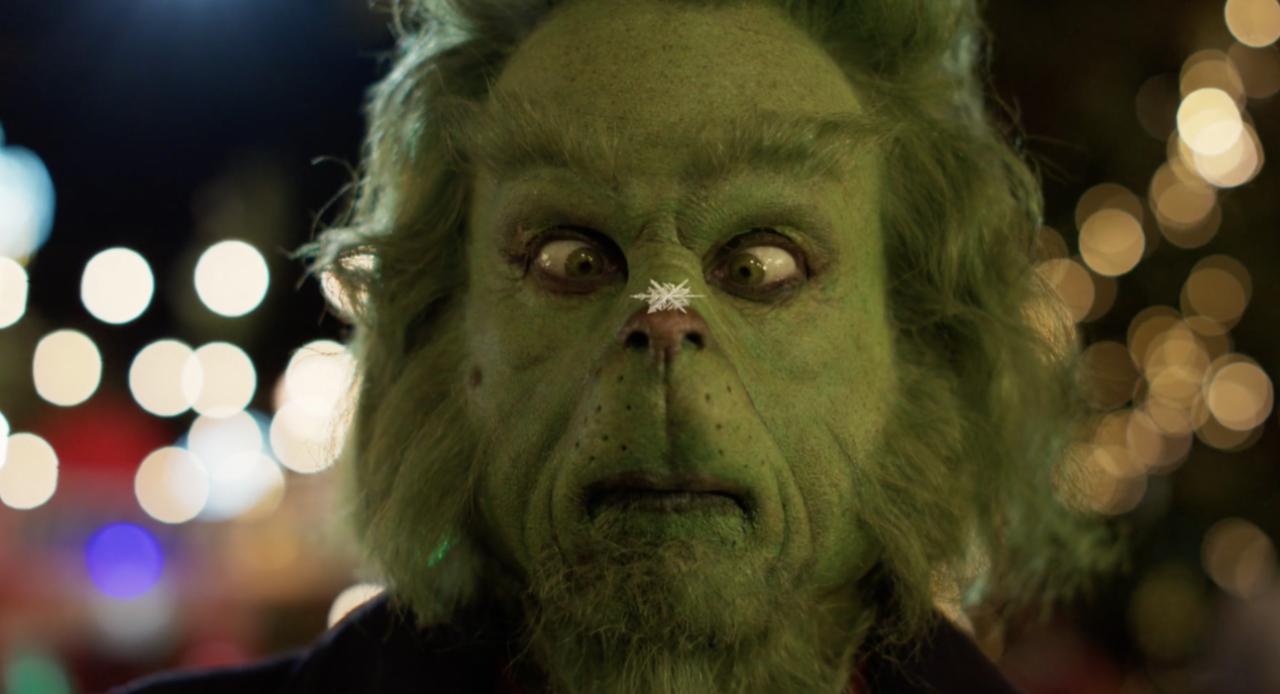
For sheer technical craft and cultural timing, Asda’s Grinch might be this year’s most audacious move. Rather than inventing a new mascot, Lucky Generals and director Dexter Fletcher reached back to a millennial touchstone – The Grinch – and rebuilt him for live-action, twenty-five years after Jim Carrey first donned the fur. Every part of this production screams painstaking detail: four hours of prosthetics a day; colour-matching to achieve the perfect “pistachio green” that looked warm under harsh supermarket light; and a performance calibrated between expressive and eerie, refined over endless prototypes.
What’s striking is how physical it all feels. In an era dominated by CGI sparkle, almost everything here was done in-camera. Fletcher (of Rocketman and Bohemian Rhapsody fame) insisted on practical magic, such as real sets, real texture, real charm. Even the vocals are intentionally imperfect: when the actor’s rough-edged singing take made the team smile, they kept it, choosing sincerity over studio polish.
The entire look was vetted by Dr Seuss Enterprises in San Diego, who worked closely on the details, like the rounded belly, the cat-like face, and the tricky yellow-green eyes that risked turning uncanny. The payoff is a character that feels nostalgic and freshly British, stomping down Asda aisles to a cabaret of party food and pyjama deals, melting even his own miserly heart in the glow of “Asda Price”.
Sainsbury’s: BFG: Unexpected Guest
New Commercial Arts brings back the BFG and pairs him with Annie, a real Sainsbury’s colleague, for a fast, warm caper that rescues Christmas spreads from a ravenous giant. It’s briskly plotted, with breadsticks restocked mid-chaos and canapés replenished through windows. It's also unapologetically food-first, using the Taste the Difference range as the story engine rather than a cutaway.
Rogue Films and Electric Theatre Collective give the world scale and sparkle while keeping the tone human, and the closing invitation to “make room at the table” crystallises the brand line, Good food for all of us in a non-preachy way. The cinema rollout alongside Wicked is also a smart frequency play.
Waitrose: The Perfect Gift
Waitrose delivers one of this year’s most cinematic and charming campaigns with a festive mini rom-com starring Keira Knightley and Joe Wilkinson. Directed by One Day’s Molly Manners, the four-minute short pays unabashed homage to Love Actually and Notting Hill, complete with meet-cute, montage, and a grand pastry-based gesture. The film finds Wilkinson reprising his “Phil” character from last year’s whodunnit ad – now a widower – before fate (and a wedge of Sussex Charmer cheddar) leads him to Knightley at the Waitrose cheese counter.
What follows is pure festive wish-fulfilment in the form of a bumbling courtship scored to James’ She’s a Star, a misunderstanding over a mysterious “Mark”, and a climactic doorstep scene where Phil reappears with a pie in hand, crust emblazoned with “I Love You.” It’s knowingly silly, gorgeously shot, and perfectly cast. Knightley plays herself with twinkly self-awareness, while Wilkinson’s deadpan everyman charm keeps the sweetness in check.
Described by Knightley as “silly, fun and delicious,” the ad cements Waitrose’s knack for wrapping genuine warmth in playful storytelling. It’s a love letter not just to Christmas romance, but to the supermarket’s own role in Britain’s collective festive imagination. As Wilkinson put it, “It was tough having to eat delicious food and fall in love with Keira, but I just got on with it, like the trooper I am.” Sweet as pie, indeed.
ALDI: Kevin’s Big Question (teaser)
To mark Kevin the Carrot’s tenth year, McCann Manchester opens with a Love-Actually-coded proposal outside Katie’s door, then pauses. It's a clever, episodic cliffhanger that buys weeks of conversation.
Notably, the teaser is lean on product and big on earned media mechanics, with ITV and radio “breaking news” tie-ins, OOH roadblocks, and a wave of short films to drip-feed the payoff. It’s Aldi’s tried-and-true Christmas serialisation, crafted to feel nationwide without overspending the reveal.
John Lewis: Where Love Lives
John Lewis has always specialised in emotional shorthand, but this year’s spot lands differently. It’s still sentimental – and yes, it still brings a tear to your eye – but its nostalgia belongs to a new generation. Directed by Saatchi & Saatchi and set to Alison Limerick’s 1990 club classic Where Love Lives (reimagined by Labrinth), the ad follows a father who finds a vinyl copy of the song under the tree from his teenage son. When the needle drops, the living room dissolves into strobe lights and memory of the dad’s youth in a 90s club, his toddler son taking first steps in flashes of light, and finally the quiet embrace that says what words can’t.
It’s gorgeous filmmaking, but what really resonates is the generational shift it signals. As our editor noted after watching: “For the first time, it’s an ad that feels millennial – Gen X, even. The boomers are on their way out; we’re the older ones now. To recognise something from our youth… well, that’s the shift happening.” The world moves fast, but some truths stay fixed, like fathers and sons, and all the things they can’t say. By framing that universal tension through a song from the parents’ own youth, John Lewis closes the loop with Christmas advertising speaking directly to the generation that grew up watching it.
Argos: Connie & Trevor x Simon Bird
T&P evolves its “intervention” platform by having mascots Connie and Trevor kidnap Simon Bird to prove Argos is more than toys. The gag plays like a Guy Ritchie pastiche – a noirish drive to a warehouse that turns out to be a cathedral of grown-up gifts – but the writing keeps it family-safe, helped by Bird’s precise deadpan and David Kerr’s brisk direction.
Because it builds straight off the autumn work, Christmas feels like chapter two rather than a seasonal detour, which is both intentional and effective.
Disney+: A Lifetime of Great Stories
Disney+ celebrates a century of storytelling with a campaign that’s as moving as it is meta. A Lifetime of Great Stories, created by VCCP and directed by Frédéric Planchon through Academy Films, traces one woman’s life through the lens of Disney’s worlds, from watching Mickey Mouse at Christmas as a child to Home Alone, Modern Family and The Bear in adulthood. Each scene is a vignette of comfort, escapism and emotional inheritance, with Mickey quietly present at every turn.
The ad is pure Disney sentiment, characterised by its cinematic nature and calibrated to remind adults that the stories they loved still shape them now. “Great stories stay with us for a lifetime and are passed down through generations,” says Emma Quartly, VP of marketing at Disney+ EMEA – and by the final shot, as the protagonist’s daughter discovers the same magic decades later, that truth lands effortlessly.
Amazon: Joy Ride (returning film)
Amazon brings back 2023’s trio of lifelong friends who rediscover sledging joy, this time positioning the return as tradition rather than rerun. An orchestral take on The Beatles’ In My Life gives it lift, while the small act – padded seat cushions ordered on the app – keeps Amazon’s role modest and human.
Instead of chasing novelty, the ad is banking on the power of recognition in a season that loves rituals.
Boots: Puss in Boots at the Snow Queen’s Ball
Boots goes full storybook with a Puss-in-Boots dash to the Snow Queen’s Ball, guided by a magic mirror through gifting stops that map neatly onto categories in store.
The tone is nimble and merch-friendly (you can almost see the end-caps) and the brand’s playful side lands without losing the sense that Boots is the high-street fix when you’ve got ten minutes and a list.
King’s Cross: Unwrap the Unexpected
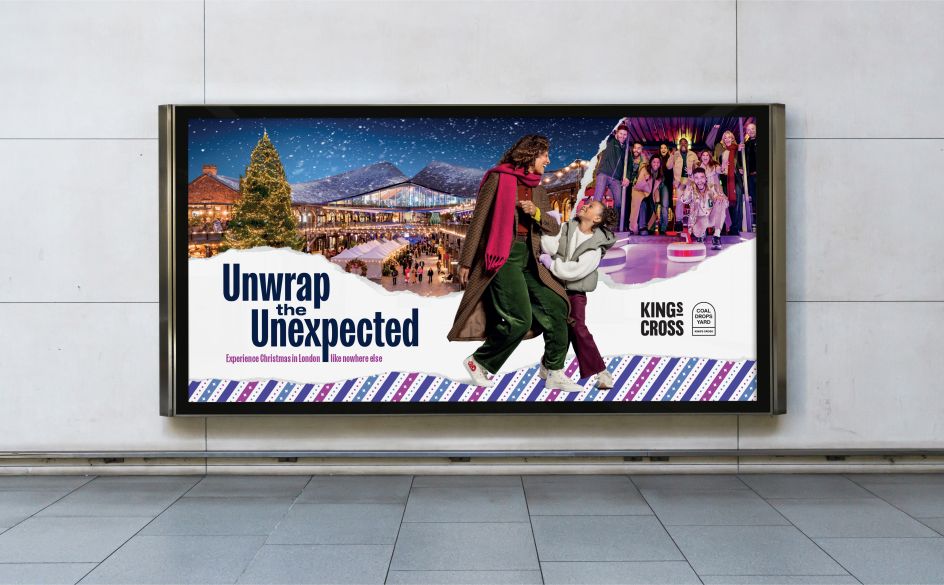
King’s Cross swaps tinsel for texture this year with Unwrap the Unexpected, a bold new festive platform from B Corp agency elvis. The campaign positions the destination as London’s antidote to high-street chaos – a place for discovery rather than stress – showcasing everything from Club Curling and seasonal dining to curated boutiques across Coal Drops Yard and King’s Boulevard.
Visually, it’s a masterclass in restraint, where torn wrapping paper becomes a graphic device revealing layers of fashion, food and culture beneath. The colour palette steps away from red-and-green cliché in favour of modern, editorial tones, with models styled head-to-toe in pieces from on-site stores. “King’s Cross has always offered something different at Christmas,” says CEO Leo Shapland. “It’s not just about shopping; it’s about discovery, atmosphere, and spending time somewhere that feels truly unique.”
By spotlighting experience as the new luxury, Unwrap the Unexpected neatly captures the mood of 2025.
Lidl: Why Do We Love Christmas So Much?
A young narrator and a gentle Beach Boys cover steer Lidl toward generosity and small kindnesses, with the nationwide Toy Bank as the concrete action. It’s understated and community-minded rather than glossy, which will resonate for many; creatively it could use one sharper goosebump beat, but the retailer’s role is credible and clear.
Morrisons: Making More of Christmas
Leo Burnett UK turns the camera on the people who make the season possible, from farmers and bakers to fishers and drivers. It tracks their year of graft to a new recording of Stop the Cavalry.
Aaron Stoller directs with documentary gloss and zero HFSS cutaways, an elegant way to navigate constraints while showing off the supermarket’s unusual vertical integration. The final reveal – a knock at the door that’s a Morrisons driver, not St Nick – lands the line “More reasons…” with a grin.
NSPCC: Most Dangerous Time
The year’s most unsettling – and arguably most vital – Christmas campaign comes from the NSPCC and GOOD Agency. Most Dangerous Time strips away every trace of tinsel to reveal the darker truth that for many children, the holidays mean isolation and fear.
Inspired by a real survivor’s story, the film follows a girl named Sarah returning home from school at the start of winter break, her whispered “ring, ring, ring” – from Ring Christmas Bells, sung by Finchley Children’s Music Group – doubling as both comfort and cry for help. Director Sara Dunlop delivers it with stark restraint: no sentimentality, just a clear, urgent reminder of why Childline exists.
Supported by an integrated fundraising campaign across TV, OOH and social, the work is an example of how Christmas advertising doesn’t always have to sell. Sometimes it can also save.
Barbour: Wallace & Gromit – A Grand Day Out at Christmas
Barbour continues its partnership with Aardman with another lovingly handcrafted stop-motion short featuring Wallace and Gromit – a pairing that’s quickly become one of the most consistent and charming staples of the Christmas ad season. In this year’s film, the eccentric inventor and his ever-patient dog take on the perils of last-minute gifting, realising that sometimes the most thoughtful present is one you make yourself.
True to Aardman’s craft tradition, every frame is sculpted, textured, and lit with tangible warmth, and the North East brand’s countryside heritage is woven subtly through the story. In a year dominated by digital polish and CGI perfection, Barbour’s clay-crafted storytelling feels reassuringly analogue in a gentle ode to handmade generosity and enduring British character.
Tesco: That’s What Makes It Christmas
Tesco ditches the single hero film this year for something refreshingly plural. That’s What Makes It Christmas, created by BBH London, unfolds as a series of standalone vignettes celebrating the gloriously chaotic moments that make the festive season feel real, not perfect. From colleagues buying last-minute Secret Santa gifts for people they barely know, to the overstuffed fridge no one’s allowed to touch, each short film zooms in on the unfiltered rituals of Christmas across the UK, united by a wink and a grin.
Directed by Jeff Low and narrated by John Bishop, the films blend observational humour with warmth – all scored to Holly Jolly Christmas – and together they position Tesco as a background constant in every kind of household. For the first time, that creative extends into products too: hand-drawn Christmas cards and tongue-in-cheek F&F jumpers that answer awkward family questions (“Yes, I’m still single”).
“It’s during the messy, weird and unscripted chaos where the Christmas spirit really kicks in,” says BBH’s Felipe Serradourada Guimaraes. While Tesco’s campaign doesn’t aim for tears or tinsel, it does acknowledge that festive magic lives somewhere between the burnt stuffing balls and the family board-game fallout.
Dogs Trust – Thank You for My Happy Place
As always, Dogs Trust is tugging on our heartstrings this Christmas with Thank You for My Happy Place, an emotive campaign by VCCP Blue celebrating the bond between dogs and their humans. The 60-second film follows a rescue dog, Buddy, and his best friend Daisy through the small, sincere rituals that make up life with a dog. It jumps from scenes of muddy walks to sofa snuggles, and cosy Christmas-morning moments. Told through Buddy’s voice, narrated by actor Mark Benton, the message is that – for a dog – the best gift is to feel safe and loved.
Directed by Neil Gorringe through Girl & Bear Studios, the spot is another example of how compassion – not consumerism – is what defines the season. The campaign extends across TV, cinema, and social channels, supported by an in-store toy, Lucy Longlegs, whose profits fund Dogs Trust’s rehoming work. “Dogs can’t say thank you, not with words,” says VCCP’s Ross Neil. “But they show it every day, in their own way.”
Lexus: Over the Years
Fleetwood Mac’s Landslide sets the tone for Lexus’ quietly moving holiday film Over the Years, created with Team One as part of its long-running December to Remember series. Rather than the usual glossy showroom fantasy, the camera lingers on family life – a daughter growing up through decades of Christmas mornings, viewed tenderly through her parents’ eyes.
Director Justyna Obasi lets the song carry the story, evoking both pride and melancholy in equal measure. It’s an advert that breathes, unhurried and cinematic, contrasting beautifully with the hyper-speed world of luxury marketing. As Team One’s Jason Stinsmuehlen notes, “You realise how quickly this all passes if you don’t take stock of every moment.” In an industry obsessed with youth and novelty, Lexus celebrates time – and the cars, and people, that stay with us through it.
Manchester City: Christmas, Together
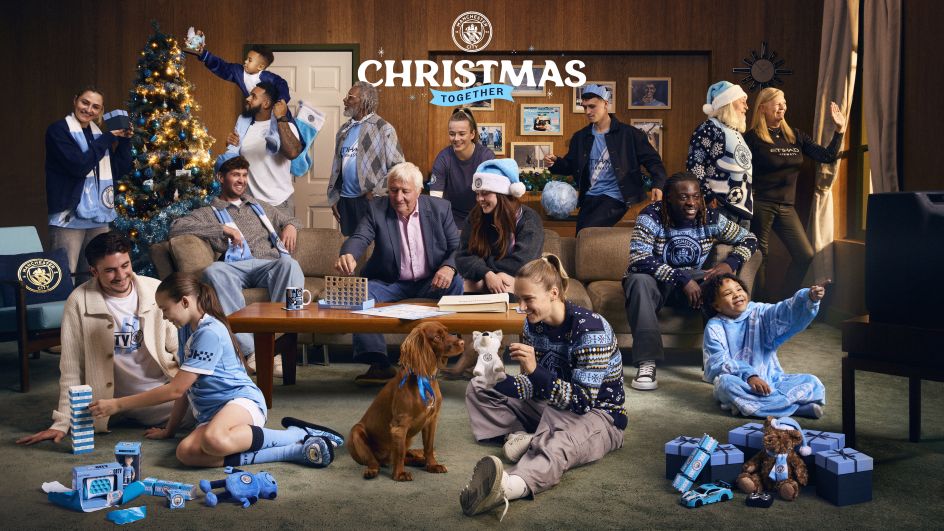
Manchester City swaps spectacle for sincerity this year with Christmas, Together, a heartfelt campaign created by the club’s in-house agency, City Studios, in partnership with City in the Community and the Royal Manchester Children’s Hospital. Set against a living room dressed in City blue, the film weaves scenes of young fans unwrapping presents with older supporters reminiscing about Christmases past, bridging generations through the shared language of football.
Cameos from Phil Foden, Laura Coombs and club legend Mike Summerbee anchor the story in authenticity, while the campaign’s purpose goes deeper: £5 from every item in City’s festive range is donated to the hospital, supporting the City Onside programme for young patients and their families.
Visually, the spot balances nostalgia with northern warmth through soft lighting, family snapshots, the gentle rhythm of connection that extends from pitch to community. “We wanted to capture the sense of warmth, connection and community that defines Manchester City at Christmas time,” says James Wilkins, executive creative director at City Football Group. “Christmas, Together is about celebrating the shared joy football brings — and using that spirit to make a real difference.”
LEGO: Hello, Is It Play You’re Looking For?
LEGO goes full showstopper this year with Hello, Is It Play You’re Looking For?, a gleeful remix of Lionel Richie’s 1984 classic performed by the brand’s own “Holiday Choir” – hundreds of animated minifigures spanning LEGO’s universe, from Darth Vader to Elphaba. The spot follows 12-year-old Eddie, who’s outgrown family fun, until his sister conjures a playful rebellion that brings him back to the fold.
Directed by Steve Ayson and produced by Our LEGO Agency, the short is built from nearly 100,000 bricks and buoyed by an infectious sense of craft. It’s riotous, silly, sincere, and a love letter to imagination itself, backed by LEGO’s Build to Give initiative, which donates sets to children in need of play. In a year of nostalgia and generational reflection, LEGO reminds us that the most meaningful gift is still time spent together – ideally, on the floor, surrounded by bricks.
Matalan: It’s Showtime
Matalan steps confidently into the spotlight this Christmas with It’s Showtime, a glitzy, high-energy campaign from McCann Manchester that turns festive prep into performance art. The 90-second hero film follows a lead character orchestrating her home as a stage – decorating, dressing and hosting with cinematic flair – capturing that crescendo of excitement before the guests arrive. What’s new here is focus: for the first time, the homeware range takes centre stage, and it’s every bit the star.
Behind the sparkle though, there is substance. Matalan’s campaign is also one of the first to be built with audio description at its core, through McCann’s pioneering “Alt by Default” accessibility initiative, ensuring visually impaired audiences experience the spectacle from the ground up. It’s a clever balance of glamour and inclusivity, reminding us that a show-stopping Christmas should be something everyone can see, hear and feel.
Theme check
This year's Christmas ads show a clear pattern. Comfort characters are everywhere. But they're being used with purpose, not just as nostalgia bait. From Kevin the Carrot to the BFG to the Grinch himself, brands are anchoring their stories in recognisable worlds that already feel safe and familiar. It's a smart move in a year where people want reassurance as much as escapism.
Music is doing a lot of heavy lifting too, not in a manipulative, tear-jerking way, but as emotional shorthand. Whether it's Alison Limerick reimagined for John Lewis, Fleetwood Mac gliding through Lexus, or The Beatles swelling through Amazon, these tracks act like happy memory triggers. They pull us back to something personal, even when the ads are big and cinematic.
What’s most striking, though, is the shift in tone. After years of high-gloss fantasy, 2025 is leaning into something warmer, more grounded, and noticeably more human. Food is front and centre. Value shows up without shouting about it. And community – whether in the form of small kindnesses, shared rituals or people who make the season possible – is where the magic actually lands.
There's still spectacle in the mix, of course. LEGO is a riot. Matalan is a showpiece. Barbour and Aardman remain reliable sources of handcrafted charm. But the overall pulse is gentler. Less flex, more feeling. Less tinsel, more truth. What does the industry think?
Eric Tsytsylin from Lippincott shares an interesting observation: "What struck me most was the tinge of tension and anxiety woven into the typically heartwarming stories, reflecting the functional and emotional impact of ongoing weak consumer sentiment. From Dawn French's M&S road rage and ASDA's revival of the Grinch to the heel turn of Argos's fuzzy mascots and LEGO's unrequited love anthem, the undercurrent of melancholy in many ways mirrors the sense of unease and tumult that communities and individuals are feeling around the world."
Eric adds: "These brands—many of which are already loved and relied on—are choosing to acknowledge, rather than sugarcoat, the truth of the public's lived experience, tastefully highlighting ways they can create moments of connection and utility, big and small, through their products and experiences.
"Whether intentional or not, another byproduct of these darker undertones is that each of these spots inspired me to take an action far more important than buying more stuff: to check in with my friends, colleagues, and loved ones, even, and especially, when things appear merry and bright on the surface." He might be onto something there.

Editor's Picks




Trending


Podcasts

Editor's Picks
Further Reading